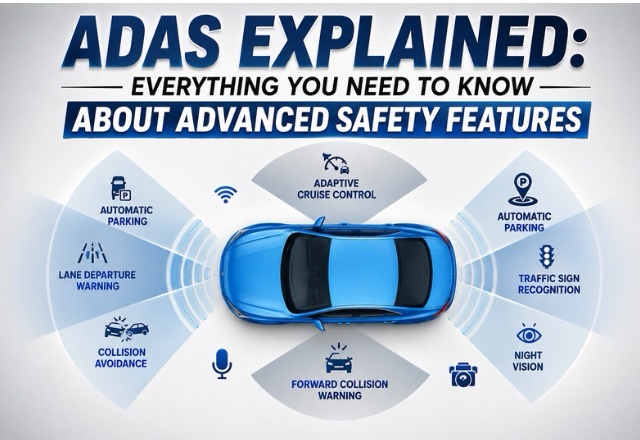
Let’s face it — driving in India isn’t getting any easier, with traffic only growing thicker by the year. That’s exactly why the ADAS system (Advanced Driver Assistance System) matters so much right now. More and more Indian carmakers are fitting it into their cars, and not just the pricier ones — you’ll find it in everything from compact SUVs to premium sedans. It’s quietly changing what everyday driving feels like.
In this guide, we’ll break down what an ADAS system actually is, how it works, where it helps (and where it doesn’t), and which cars in India currently offer it.
What is ADAS?
ADAS stands for Advanced Driver Assistance System, but in plain terms, it’s just a bunch of smart tech packed into your car to help you avoid accidents and drive with a bit more confidence. Picture it as an extra set of eyes and reflexes riding shotgun, always watching the road with you.
Why do carmakers bother with this stuff? Simple, most accidents happen because of human error. A split-second of distraction, feeling drowsy on a long drive, or just not spotting something in your blind spot, that’s usually all it takes. This is where the ADAS system quietly steps in, catching what you might miss before it turns into a real problem.
It also helps to know the difference between active and passive safety. Passive safety, think airbags and seatbelts kicks in after a crash has already happened. An ADAS system works the other way around. It’s active, meaning it’s trying to warn you or step in before things go wrong in the first place. That’s really the whole reason this kind of tech has gone from a nice extra to something people actively look for when buying a car.
How Does ADAS Work?
Sounds fancy, but it’s really not that complicated once you break it down. Here’s what’s actually going on:
- Cameras — Sitting on the windshield or bumpers, keeping an eye on lane markings, traffic signs, pedestrians, whatever’s around you.
- Radar sensors — Usually up front and at the back- track how far away other vehicles are and how fast they’re moving, even when it’s hard to see.
- Ultrasonic sensors — These handle the close-up stuff, mostly when you’re parking.
- The car’s computer (ECU) — Everything the sensors pick up gets sent here, and it figures out in real time what needs to happen next.
Basically, it all comes down to this:
Sensors → Detect → Analyze → Warn or Assist
So the sensors catch what’s happening around you, the ECU makes sense of it almost instantly, and then the car either gives you a heads-up or does something small on its own, like tapping the brakes for you.
Most Common ADAS Features
Not every car with an ADAS feature is built the same — different models offer different combinations of features. Here are the most common ADAS features you’ll find in Indian cars today.
This feature automatically adjusts your car’s speed to maintain a safe distance from the vehicle ahead. On long highway drives, it takes the constant throttle adjustments off your hands, making the journey noticeably less tiring.
- Automatic Emergency Braking (AEB)
If the system senses an imminent collision and you haven’t reacted in time, AEB applies the brakes on its own. It’s one of the most important ADAS features because it can prevent — or at least reduce the severity of — a crash in split-second situations.
Using the front camera, this feature monitors lane markings and gently nudges the steering if you drift out of your lane without indicating. It’s especially useful on long, monotonous highway stretches where drowsiness can creep in.
Every car has blind spots that mirrors just can’t cover. This feature uses rear-mounted sensors to alert you when a vehicle is lurking out of sight, which is especially handy during lane changes in heavy traffic.
This system tracks driving patterns, like erratic steering or lane drifting, to detect signs of fatigue or distraction. If it senses you’re losing focus, it prompts you to take a break, a small nudge that can prevent a big mistake.
Together, these features of the ADAS system work as a safety net, catching small errors before they turn into big problems.
What Are the Pros and Cons of ADAS?
Here’s the honest breakdown of what the ADAS system actually does well and where it falls short.
Pros
- Warns you about danger before it becomes an actual problem
- Highway drives don’t wear you out as much anymore
- Parking is honestly a lot less of a hassle now
- You just drive with a bit more peace of mind
Cons
- You’re still the one driving; this just backs you up
- Doesn’t handle rain or fog too well
- Sensors collect dirt fast and need cleaning often
- It’s support, not something that takes over for you
FAQs: ADAS System
- What do ADAS Levels 1, 2, and 3 actually mean?
Level 1 is your basic stuff, like adaptive cruise control. Level 2 takes it further and handles steering and speed together, but you’re still expected to stay alert. Level 3 is where the car can actually manage things on its own for a bit, though you’ve gotta be ready to jump back in.
- Which cars actually have Level 3 ADAS?
Abroad, cars like the Mercedes-Benz S-Class and EQS have Level 3 certification, but only in places where it’s legally allowed. Here in India, we’re still mostly stuck at Level 2, even in the pricier cars.
- Can you just switch off ADAS if you want to?
Yeah, totally. You can turn off stuff like lane keep assist or forward collision warning from the screen or a button in most cars. Just know some of it might quietly turn itself back on next time you start the car.
- So which cars actually have good ADAS in India?
Right now, good options are the Mahindra XUV700, Hyundai Creta, Kia Seltos, Honda Elevate, MG Hector, and Tata Harrier EV. They come loaded with Level 2 stuff like adaptive cruise control and automatic emergency braking.
- What’s the cheapest car you can get with ADAS?
That’d be the Honda Amaze, hands down. Get the higher variant, and you’ll get emergency braking, lane-keep assist, and adaptive cruise, all without spending premium-car money.
Final Words
The ADAS system is quickly reshaping how we think about car safety in India. It won’t drive the car for you, but it will watch your back when it matters most. As ADAS becomes more common across segments, it’s shifting from a premium add-on to a genuine safety essential — one that every conscious car buyer should seriously consider.