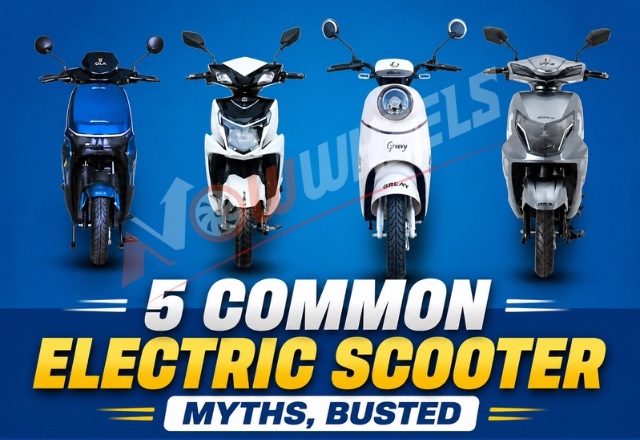
Walk into any scooter showroom in India today, and you’ll notice something: electric models are no longer tucked away in a corner. They’re front and centre, thanks to lower running costs, quieter rides, and a lot less fuss at the petrol pump. Yet ask around, and you’ll still hear the same old doubts: someone’s cousin’s battery “died in a year,” someone’s neighbour “got stranded” mid-trip.
These electric scooter myths refuse to die, even though most were only ever half-true, and that was years ago. This article takes five of the most common EV scooter myths and stories doing the rounds and checks them against what’s actually true in 2026.
Myth 1: Electric Scooters Don’t Offer Enough Range
Of all the electric scooter myths out there, this one’s the oldest, and it didn’t come from nowhere. Early electric scooters in India genuinely struggled to go past 60 km on a full charge, fine for errands but useless for longer trips. That frustration turned into one of those EV scooter myths and stories that stuck around long after those models were discontinued.
Today’s scooters aren’t the same machines. Most now manage 90–150 km on a single charge, with premium models going further. Better batteries, smarter motors, and improved aerodynamics have closed that gap.
This myth mostly hurts first-time buyers comparing outdated word-of-mouth with current models. If you commute 20–40 km a day, you’d charge once every two or three days at most, hardly one of the real EV scooter myths or problems anymore.
Myth 2: Charging Takes Too Long
This one comes from comparing apples to oranges. Petrol takes two minutes at the pump, so charging feels slow by comparison. But that’s not how EV scooter myths like this should be judged; charging fits your routine, not a fuel-stop mindset.
Home charging means plugging into a regular socket overnight, typically 4–6 hours, and waking up to a full battery. Public charging points work more like quick top-ups during the day. Several newer scooters also support fast charging, taking you from 0–80% in under an hour.
A couple of tips: avoid draining the battery to zero repeatedly, and always use the manufacturer’s charger. Do that, and charging stops being one of the electric scooter myths that people love to complain about.
Myth 3: Electric Scooters Are Too Expensive
This is one of the more stubborn EV scooter myths in India, and it isn’t entirely baseless; upfront prices can run a bit higher than petrol equivalents. But stopping the comparison there misses the bigger picture.
Running costs are dramatically lower, charging costs a fraction of what petrol would for the same distance, and that adds up fast. Maintenance savings help too: fewer moving parts mean no oil changes and fewer service visits. Add in subsidies and lighter servicing bills, and the higher purchase price often pays for itself within a couple of years.
Factor in the full total ownership cost, purchase price, charging, maintenance, resale, and electric scooters frequently come out ahead. That’s the real story behind most electric scooter myths and facts debates: people compare sticker prices and stop there.
Myth 4: Batteries Need Frequent Replacement
Much of this anxiety comes from assuming EV batteries behave like old smartphone batteries, losing charge fast and dying young. It’s understandable, but it’s one of the more common electric scooter myths that doesn’t match reality.
Most lithium-ion batteries today are rated for 3,000–5,000 charge cycles- several years of daily riding before any real performance dip. Warranty coverage of 3 years or more from reputable brands backs this up, and good charging habits avoiding extreme heat, not overcharging, using certified chargers, help batteries age gracefully.
Replacement is usually only needed after years of use, once performance visibly drops, not on some arbitrary early timeline. Treating it as inevitable is one of those electric scooter myth issues that just doesn’t hold up.
Myth 5: Electric Scooters Are Unsafe
Safety deserves real attention, but much of what circulates is exaggerated, feeding electric scooter myths and stories where one news clip becomes “these things just explode.”
Most past incidents have been traced back to poor-quality, uncertified battery packs, not the technology itself, and manufacturers have since tightened standards considerably. Modern scooters now come with battery management systems, thermal cutoffs, water resistance, and crash sensors that actively guard against overheating.
Choosing certified batteries from established manufacturers is the single biggest safety factor. Pair that with sensible charging habits, ventilated spaces, original chargers, and avoiding charging right after a hot ride, and “unsafe” becomes one of the weakest electric scooter myths still floating around.
Tips Before Buying an Electric Scooter
If u want to buy a perfect EV scooter, you can follow these tips to find the best EV scooter.
- Check the real-world range.- Ask actual owners what they get day to day — brochure figures rarely hold up in real traffic.
- Compare battery warranties- they differ more than you’d think, so don’t assume every brand covers you the same way.
- Look for a solid service network near you- a great scooter isn’t much use if the nearest service centre is an hour away.
- Think through how you’ll charge it- will you mostly charge at home, rely on public stations, or need a bit of both?
- Take it for a test ride- No spec sheet can tell you how a scooter actually feels once you’re riding it.
FAQs: Electric Scooter Myths in India
- Are electric scooters worth buying in India?
Yes, lower running costs, less maintenance, and an expanding charging network make them a practical daily choice.
- How long does an electric scooter battery last?
Around 3–5 years, or 3,000–5,000 charge cycles, with warranties usually covering a good stretch of that.
- Is it safe to charge an electric scooter at home?
Yes, use the original charger, a standard socket, and a ventilated space away from direct heat.
Final Verdict on EV Scooter Myths in India
Range, charging time, cost, battery life, safety: these five electric scooter myths have kept buyers on the fence far longer than they should. Today’s electric scooters have moved well past the shortcomings that created them. Next time one comes up, check current facts instead of repeating an old electric scooter myth, benefits, or features debate that stopped being true years ago. With better range, faster charging, lower running costs, and stronger safety, electric scooters have earned a real look.