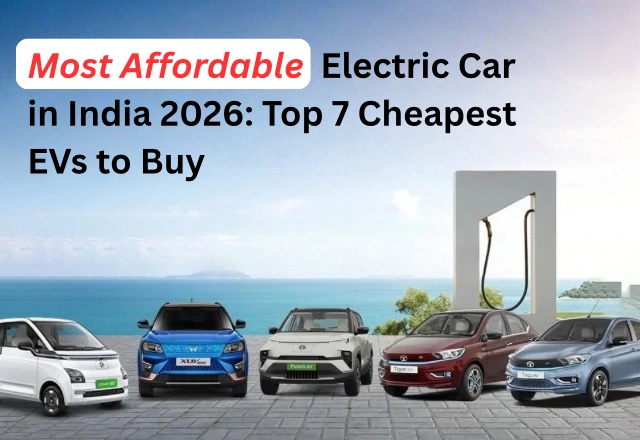
Not long ago, buying an electric car in India meant either stretching your budget or settling for something that barely felt like a “real” car. That’s changed a lot faster than most people realise. Tata just launched the new Tiago EV nearly ₹1 lakh cheaper than the outgoing model, and it’s not a one-off deal; it’s part of a bigger shift happening across the whole market right now.
Petrol keeps getting pricier, EVs keep getting cheaper, and honestly, the gap between “affordable” and “actually decent” has pretty much closed. So if you’ve been putting off going electric because you assumed it’d cost too much, it might be worth taking another look.
In this guide, we’re ranking the most affordable electric cars in India currently on sale, seven models, cheapest first, with real prices, range, and an honest read on what each one’s actually good for.
Why Affordable EVs Are Booming in India Right Now
A few things are lining up at once to make an electric vehicle in India a genuinely realistic buy. First, EVs are taxed at just 5% GST compared to 28%+ on petrol and diesel cars; that alone shaves a meaningful chunk off the sticker price.
Then there’s the government’s continued push through schemes like FAME III and the PM E-Drive initiative, both aimed at getting more EVs on Indian roads through subsidies and infrastructure support.
And on top of all that, petrol prices keep climbing, which makes the monthly running-cost gap between EVs and petrol cars wider every year. Put it together, and it’s no surprise that carmakers are racing to launch cheaper models, and that the most affordable electric car in India keeps getting easier to find.
Top 7 Most Affordable Electric Cars in India (2026)
Not sure which one to pick? Here’s the full lineup of the best affordable electric cars in India right now, ranked from affordable EV cars, so you can see exactly where your budget lands.
| Sno |
Model |
Price Range |
Segment/Type |
Highlights |
| 1 |
Tata Tiago EV |
₹6.99–9.99 Lakh |
Compact Hatchback |
Two battery options (19.2 kWh / 24 kWh), up to 315 km range, Tata’s massive service network, and the go-to pick for first-time buyers |
| 2 |
MG Comet EV |
₹6.99–7.5 Lakh |
Micro/City Car |
Ultra-compact 2-door design, built for tight city traffic and parking, skip it if you drive highways often |
| 3 |
Tata Punch EV |
₹8.09–12.79 Lakh (from ₹6.49 Lakh on BaaS) |
Compact SUV |
40 kWh battery, up to 468 km range, 20-80% fast charge in ~26 mins, SUV looks at near-hatchback pricing via BaaS |
| 4 |
Citroen eC3 X |
₹11.99 Lakh |
Compact Hatchback |
Comfortable ride quality, a genuine sleeper pick just above the sub-₹12L crowd |
| 5 |
Tata Tigor EV |
₹12.49 Lakh |
Compact Sedan |
Boot-and-cabin layout for buyers who’d rather have a sedan than a hatchback |
| 6 |
Tata Nexon EV |
₹12.49–17.19 Lakh |
Compact SUV |
India’s best-selling EV since 2020, two battery packs (30 kWh/275 km or 45 kWh/489 km), 5-star Bharat NCAP rating, 15-year battery warranty on the 45 kWh version |
| 7 |
MG ZS EV |
₹17.99–20.50 Lakh |
Mid-size SUV |
Biggest battery here (50.3 kWh), longest range at 461 km claimed, 488-litre boot, more premium cabin with a 12.3″ touchscreen |
Worth noting: the top end of this list (like the MG ZS EV) is less ‘budget’ and more ‘affordable relative to premium EVs.’ If your ceiling is strictly under ₹10 lakh, the Tiago EV, Comet EV, and Tata Punch EV are really where you want to focus.
How to Choose the Best Affordable EV for You
Finding the most affordable electric car in India for your needs really comes down to four questions.
How far do you actually drive daily?
If it’s mostly short city hops, the MG Comet EV or Tata Tiago EV will more than cover it; no need to pay extra for range you won’t use. MG has also been expanding its EV lineup. Check out The New MG EV Car for what else they’ve launched recently.
Can you charge at home or work?
If yes, almost any option on this list works well. If you’re relying on public charging, prioritise faster-charging models like the Punch EV or Nexon EV. Tata recently refreshed the Punch EV with a bigger battery and lower BaaS pricing. See the full breakdown in the New Tata Punch EV Facelift.
City-only or the occasional highway trip?
For mixed use, the Nexon EV or ZS EV gives you more breathing room than the smaller city-first EVs like the Comet. See the Tata Nexon EV Max vs MG ZS EV to choose the right electric car for you.
What’s your actual budget ceiling?
Don’t just look at the sticker price; check if a BaaS (Battery-as-a-Service) option is available, since it can meaningfully lower your upfront cost, like it does on the Punch EV.
Affordable EV vs Petrol Car: Is It Worth It in 2026?
The numbers genuinely stack up in favour of going electric right now. Charging an EV typically costs ₹1,000–2,000 a month for average driving, compared to ₹6,000–8,000 for petrol over the same distance; that’s real money back in your pocket every single month.
Add in lower maintenance (no oil changes, fewer moving parts to service) and cheaper insurance on some models, and the savings compound fast, even before factoring in the lower GST you paid at purchase.
Resale value is really the last hurdle for budget EVs — established petrol models still hold their value better for now. But that gap is shrinking fast as the electric vehicle market in India matures, which makes buying an affordable EV a much easier call than it was even a couple of years ago.
What Are the Advantages of Buying an Electric Car?
Beyond the price tag, there are real reasons buyers are switching:
For your wallet:
- Lower running costs, electricity is far cheaper per kilometre than petrol
- Reduced maintenance, no oil changes, fewer mechanical parts to wear out
- Lower GST and, in many states, road-tax waivers or registration discounts
For the environment:
- Zero tailpipe emission, no exhaust, no local air pollution from the car itself
- Lower overall carbon footprint, especially as India’s electricity grid adds more renewable capacity
- Quieter roads, which matter more than people expect once you’re used to them
For everyday driving:
- Instant torque means smoother, quicker acceleration than most petrol cars in the same price bracket
- Home charging means you can skip fuel-station queues entirely
- Regenerative braking reduces wear on brake pads over time
Put together, the case for the most affordable electric car in India isn’t just about being eco-friendly anymore; it genuinely saves you money too.
FAQs: Most Affordable Electric Car in India 2026
1. What is the most affordable electric car in India right now?
The cheapest electric car in India right now is the Tata Tiago EV, priced from ₹6.99 lakh. The MG Comet EV is the next most affordable option, also starting around ₹6.99–7.5 lakh.
2. Are affordable EVs safe and reliable?
Yes, affordable EVs in India are safe and reliable. Budget models come with standard safety features and battery warranties of up to 8 years or 1.6 lakh km. The Tata Nexon EV holds a 5-star Bharat NCAP safety rating.
3. How much does it cost to charge an EV in India?
Charging an EV in India costs roughly ₹1,000–2,000 per month for average daily driving, compared to ₹6,000–8,000 per month for an equivalent petrol car.
4. Is a subsidy available for affordable electric cars in India?
Yes, a subsidy is available for electric cars in India. All EVs get a flat 5% GST nationally, plus state-level incentives like road-tax waivers and purchase subsidies under schemes such as FAME III.
Closing Thoughts
At the end of the day, the right EV for you comes down to two things: your budget and how you actually drive day to day. Someone doing short city runs doesn’t need the same car as someone commuting on highways every week, and thankfully, you’re no longer stuck picking between “affordable” and “good.” From the pocket-friendly Tiago EV all the way up to the feature-loaded ZS EV, there’s a solid option waiting at almost every price point.
If keeping costs down is your main priority, the most affordable electric car in India right now is still the Tata Tiago EV, but as this list shows, going affordable doesn’t mean settling anymore.
Ready to compare and book a test drive? Browse the latest budget EVs on NowWheels.